
Patricia Bath
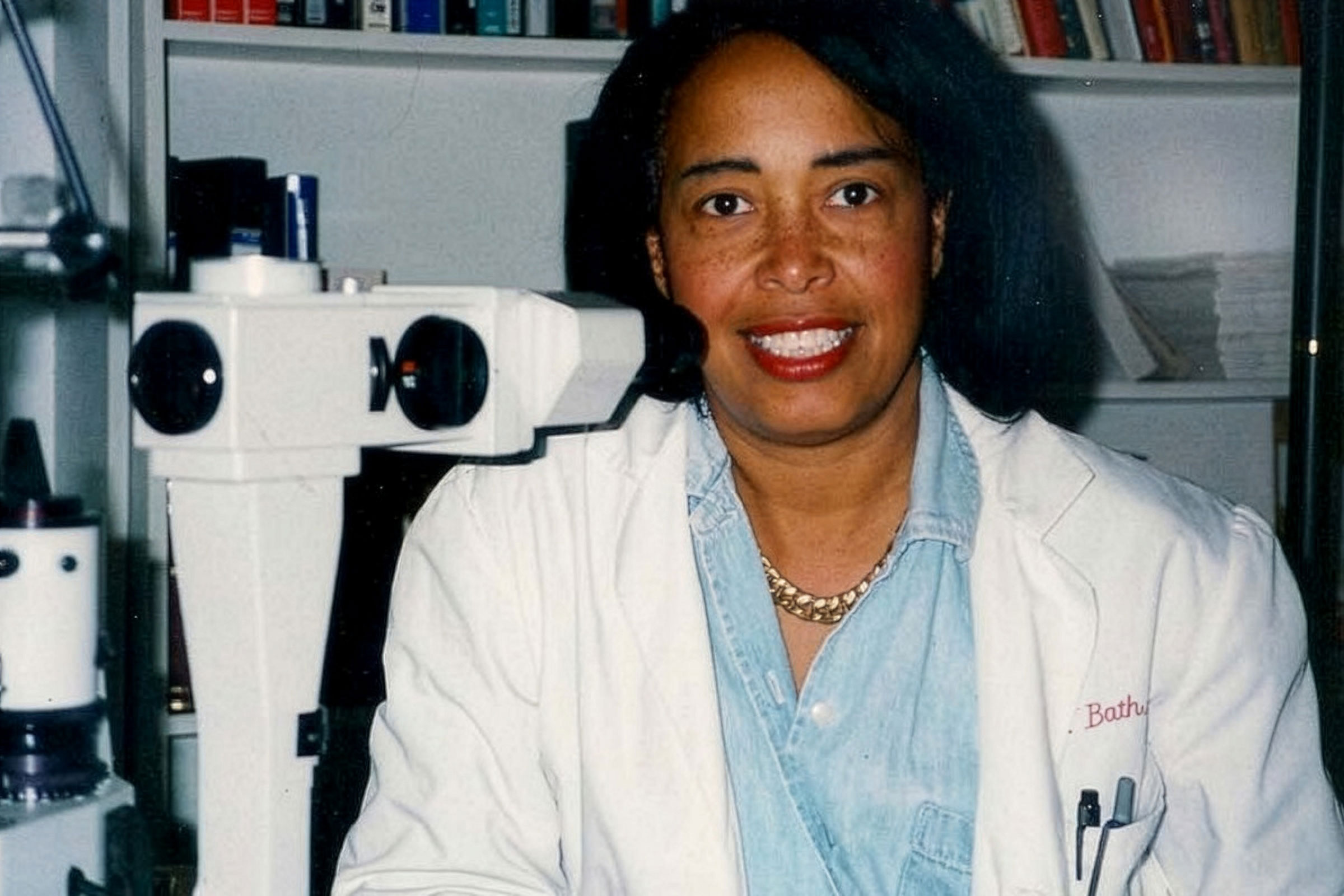
The pioneering African American ophthalmologist and inventor
Patricia Era Bath is born on 4 November 1942 in Harlem, New York City. Her father works as a subway motorman and is the first African American to hold this position, while her mother works as a domestic helper to support the family. Her parents encourage Patricia to read, explore the world and pursue her dreams.
From an early age, she loves reading and is fascinated by science. When her mother gives her a chemistry set, her enthusiasm grows even further. She excels at school and, before graduating, is selected for a research programme run by the National Science Foundation at Yeshiva University. There, she takes part in research into the growth of cancer cells. She is still a teenager, but her work is already gaining recognition and is presented at a scientific conference in Washington, D.C.
In 1964, she graduates in chemistry from Hunter College in New York City and goes on to study at Howard University College of Medicine in Washington, D.C. She graduates in 1968 and returns to New York, where she begins her medical training at Harlem Hospital. During this period, the assassination of Martin Luther King Jr. and the struggle for equal rights have a profound impact on her. She takes part in the anti-poverty campaign and organises medical students to volunteer their services for people who struggle to access healthcare.
At Harlem Hospital, she observes that Black patients face a greater risk of eye problems than patients treated at other hospitals. She realises that access to eye care should not depend on a person’s income or where they live. Taking the initiative, she works with doctors from Columbia University to provide eye examinations and surgery at Harlem Hospital. In this way, she begins to develop a new approach known as community ophthalmology, which combines medical care with prevention and public education.
Bath continues her training in ophthalmology and specialises in eye surgery, including corneal transplantation. In 1974, she moves to Los Angeles to work at the University of California, Los Angeles (UCLA), where she becomes the first woman on the faculty of its Department of Ophthalmology. Despite the barriers she faces as a woman and as an African American in the scientific world, she continues her research and advocates for equal opportunities in medicine.
In 1977, she co-founds the American Institute for the Prevention of Blindness, which aims to promote the prevention of sight loss and equal access to eye care.
Her dedication to preventing blindness leads her to an important invention. In 1981, she comes up with the idea for the Laserphaco Probe, a device that uses laser technology to help remove cataracts with greater precision and through a smaller incision. After years of research and testing, she secures a US patent for her invention in 1988. She thus becomes the first African American woman physician to receive a US patent for a medical invention. Over the course of her career, she obtains a total of five US patents.
Bath continues to conduct research, teach and advocate for equal access to healthcare. Through her work, she shows that science can provide solutions to real-world problems and that a person’s background or gender should not determine whether they can become a scientist or inventor.
Patricia Bath dies on 30 May 2019, at the age of 76, from complications related to cancer. Her work, however, continues to inspire doctors, researchers and young people who dream of discovering something that will make the world a better place.
Sexism, racism and relative poverty were the barriers I faced as a young girl. There were no women doctors. Surgery was a male profession.
Explore
1. Try reading an eye chart!
Ophthalmologists use a chart with symbols of different sizes to check how clearly we can see. This chart is called a visual acuity chart and may include letters, numbers or pictures. During an eye examination, the ophthalmologist checks each eye separately.
Find an eye chart with pictures here. Print it on a large sheet of paper and place it some distance in front of you. Cover one eye and try to identify the pictures. Which ones can you see most easily? Which are harder to make out? This activity is a game of observation and does not replace an eye examination by an ophthalmologist.
Now, create your own eye chart using pictures of your choice!
2. Explore through touch!
People who are blind or have significant sight loss often use touch to explore objects and recognise shapes. You can try discovering patterns without looking at them, too!
You will need a piece of cardboard and some white craft glue. Use the glue to draw lines, shapes, houses or anything else you can imagine, then leave it to dry completely. Next, close your eyes and carefully feel the raised patterns with your fingertips. Which ones can you recognise through touch alone? Which are more difficult to identify?
3. Discover the Eyes in Famous Paintings!
Ophthalmologists aren’t the only ones interested in eyes — great artists are, too! Many love painting portraits, capturing people’s faces in as much detail as possible.
So, which are the most famous eyes in the history of art? Click here and discover which painting each pair of eyes belongs to. What might the people in the paintings be thinking? How might they be feeling?
Don’t forget to paint your own portrait, paying special attention to the eyes!