
Mae Carol Jemison
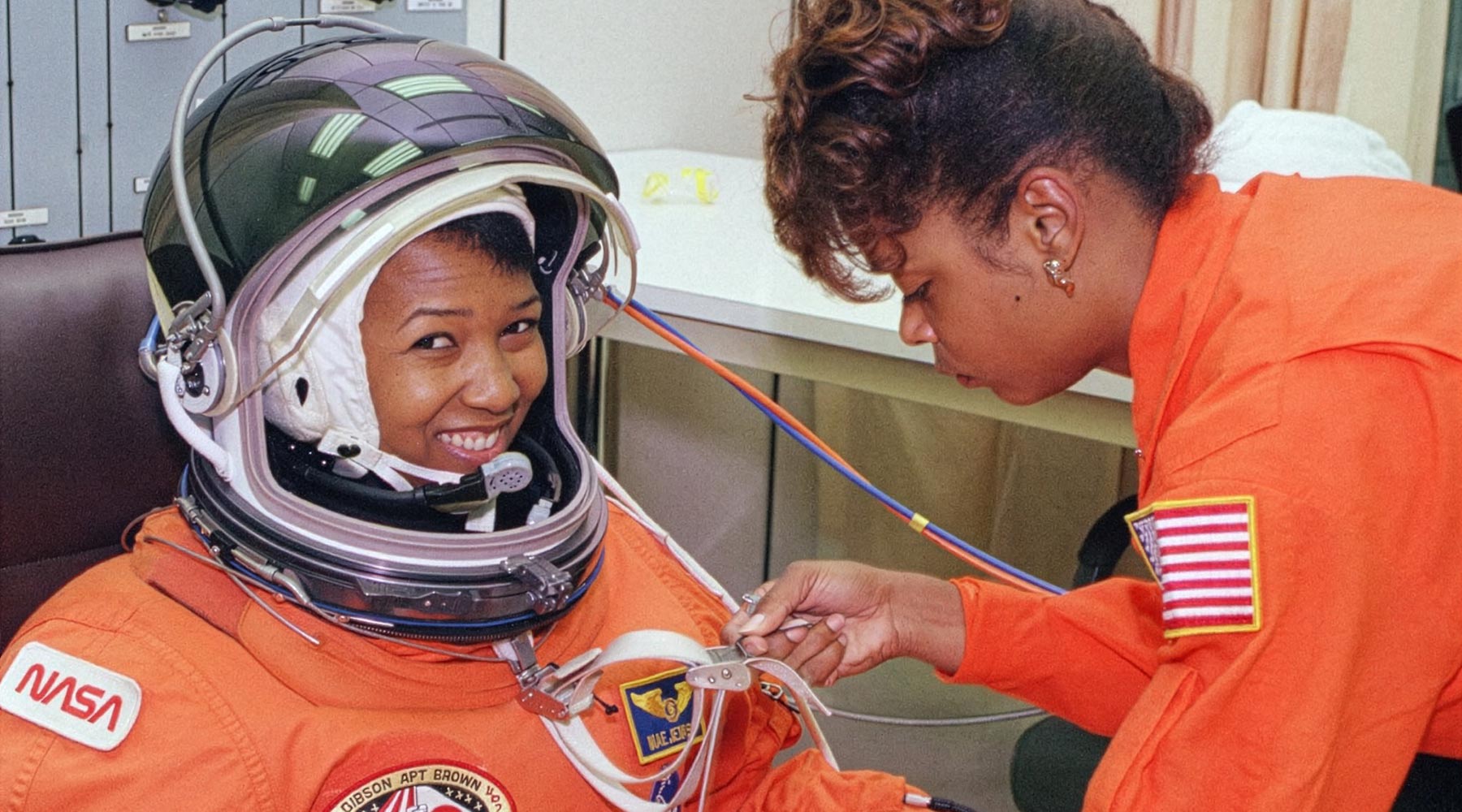
Engineer, physician and scientist. The first African American woman to travel into space as a NASA astronaut
Mae Carol Jemison is born on 17 October 1956 in Decatur, Alabama, and grows up in Chicago. From a very young age, she loves reading, and her dream is to travel into space! She reads books nonstop and watches science fiction films and television series, including Star Trek. Her role model is actress Nichelle Nichols, who plays Lieutenant Uhura in the series.
Jemison develops an early interest in nature, science and the human body. She observes the world around her and is always looking for new knowledge. Her parents encourage her scientific curiosity and support her education. At just 16, she begins studying at Stanford University, where she earns a Bachelor of Science degree in Chemical Engineering and fulfils the requirements for a Bachelor of Arts degree in African and Afro-American Studies. In 1981, she earns her medical degree from Cornell University. She then works as a doctor, providing medical care to people who need it. Among other roles, she serves as a medical officer with the Peace Corps in Liberia and Sierra Leone, in West Africa.
Despite the challenges she faces throughout her education and career, both because of the colour of her skin and because of her gender, she never gives up on her dream of travelling into space. In 1985, she submits her first application to NASA’s astronaut training programme. Following the Space Shuttle Challenger disaster in 1986, the selection process is put on hold. Jemison does not give up. She applies again and, in 1987, is selected as one of 15 astronaut candidates from a pool of more than 2,000 applicants!
Jemison joins NASA’s 1987 astronaut group, known as “Astronaut Group 12”. That same year, the Associated Press describes her as “the nation’s first Black female astronaut”. Her dream comes true! On 12 September 1992, she travels into space aboard the Space Shuttle Endeavour as part of the STS-47 mission, a joint scientific mission between the United States and Japan. As a Mission Specialist, she takes part in experiments involving life sciences and materials science. During the mission, which lasts almost eight days, she spends 190 hours, 30 minutes and 23 seconds in space and completes 126 orbits around Earth. She becomes the first African American woman to travel into space. In March 1993, she leaves NASA, ready to pursue new paths.
She goes on to work in research, education and the development of new technologies. Her love of science goes hand in hand with her interest in the arts, especially her favourite television series, Star Trek. In 1993, actor LeVar Burton invites her to appear in Star Trek: The Next Generation. Jemison appears in an episode as Lieutenant Palmer, becoming the first real-life astronaut to appear in the series!
Jemison founds the Jemison Group, a technology consulting company that helps integrate scientific, engineering and social perspectives into the design and development of projects. She is also a passionate supporter of science education and encourages children to explore the world of science, regardless of their gender or skin colour. Through her work and initiatives, she continues to inspire young people to follow their own paths and never stop dreaming.
Don’t let anyone rob you of your imagination, your creativity, or your curiosity. It’s your place in the world; it’s your life. Go on and do all you can with it, and make it the life you want to live.
Explore
1. Women Who Paved the Way in Science
Mae Carol Jemison is the first African American woman to travel into space as a NASA astronaut. The first woman to travel into space was Soviet cosmonaut Valentina Tereshkova, in 1963. You can read more about her here.
Which other women who made pioneering contributions to science do you know? What did they discover through their research? How did they help advance science? Discover here some of our favourite science books that you’ll definitely want to read!
2. How Do Astronauts Live and Work?
An astronaut is a space traveller! Astronauts are trained to travel into space and work aboard a spacecraft or space station. They learn how to live and work in confined spaces, take care of their bodies and eat in microgravity, where objects appear to float.
Watch here an astronaut at work. Inside a spacecraft, astronauts usually wear their regular clothes. But when they go outside into space, they need special spacesuits that protect them and help them survive. Look at the photographs below and see if you can find the astronaut’s spacesuit.
Now download the Museum’s activity sheet here. How would you design an astronaut’s spacesuit? What do you imagine spacesuits will look like in the future?
3. Travelling into Space
A spacecraft is a vehicle designed to travel through space. On 12 April 1961, Soviet cosmonaut Yuri Gagarin becomes the first human to travel into space aboard the Vostok 1 spacecraft. His journey lasts approximately 108 minutes and marks a major milestone in the history of space exploration.
Since then, technology has advanced dramatically! Today, people can not only travel into space but also live aboard space stations for extended periods. Take a look here at NASA’s Orion spacecraft, designed for missions beyond low Earth orbit, including journeys to the Moon.
How about building our own spacecraft? Print out the Museum’s spacecraft template here. Colour it in however you like, cut it out and join the two sides together. Leave an opening at the bottom, insert a straw and blow! What happens?
You can also attach your spacecraft to a cardboard tube. How could you launch it?